
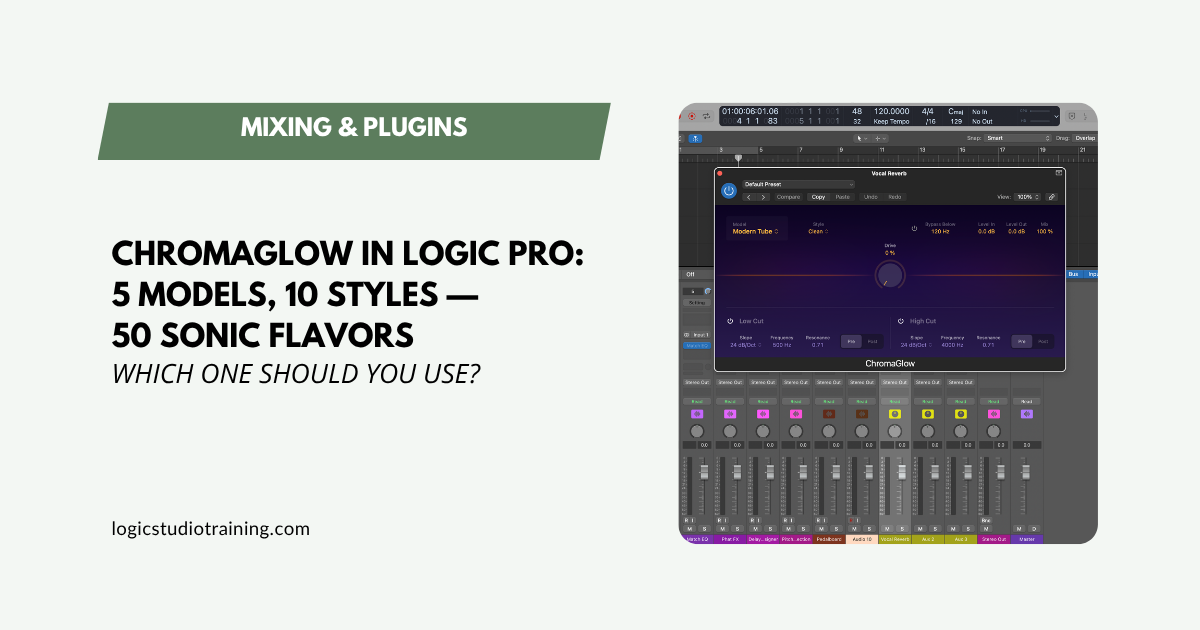
ChromaGlow is one of Logic Pro's most versatile plugins, and most producers only scratch the surface of what it can do.
It's built around five distinct Models, each with two Styles. That combination gives you 50 different tonal options, ranging from gentle tape warmth to aggressive transistor crunch, all without leaving Logic.
This guide breaks down every Model and Style, gives you practical settings for common instruments, and shows you how to use the Drive, Mix, and Bypass Below controls to dial things in fast.
If you want a quick reference to keep next to your session, download the ChromaGlow Cheat Sheet before you dive in.
Step 1: Know Your 5 Core Models
Each Model shapes your tone differently. Think of it like switching instruments — the same playing style through different gear produces a completely different result.
Here's the quick rundown:
- Retro Tube: Emulates old-school vacuum tube gear. Warm, cozy, and slightly soft around the edges. Great for instruments that need to feel lived-in.
- Modern Tube: Smoother and cleaner than Retro Tube, but still rich. Good for pop vocals and polished productions where you want warmth without muddiness.
- Magnetic: Tape machine saturation. Thick, organic compression that makes drums thump and guitars feel heavier. The go-to for that classic analog glue.
- Squeeze: Compression-driven distortion. Useful for making a kick drum punch harder or adding raw attitude to a vocal without reaching for a separate compressor.
- Analog Preamp: Transistor-based saturation with edge and bark. Adds grit and presence without getting muddy.
If you want a track to feel vintage and warm, start with Retro Tube or Magnetic. If you want something more urgent and cutting, reach for Squeeze or Analog Preamp.
Step 2: Pick Your Style to Fine-Tune the Flavor
Each Model has two Styles, Clean and Colorful. The Style determines how far ChromaGlow pushes the character of the Model.
| Model | Clean Style | Colorful Style |
|---|---|---|
| Retro Tube | Smooth warmth with slight softening | Heavier character with deliberate muddiness |
| Modern Tube | Transparent warmth with sharp clarity | Vintage-style glow with modern fidelity |
| Magnetic | Clean tape warmth without transformer grit | Saturated, harmonically rich, transformer-loaded tape |
| Squeeze | Gentle compression (Soft Press) | Aggressive, gritty compression (Hard Press) |
| Analog Preamp | Cleaner transistor saturation | Vintage woolly distortion with soft clipping |
Start by picking a Model based on the sound you're after, then use the Style to control how dramatic it gets.
For a soul ballad vocal, Retro Tube > Clean wraps the voice in warmth without smearing the consonants. For a heavy guitar riff, Analog Preamp > Colorful adds the transistor crunch that cuts through a dense mix.
The ChromaGlow Cheat Sheet has this table plus recommended settings for every instrument — worth keeping open in a second window.
Step 3: Use Drive, Mix, and Bypass Below to Control the Amount
ChromaGlow gives you three controls to shape exactly how much saturation hits the signal and where.
- Drive Knob: Sets how hard you're pushing the saturation. Small amounts add subtle texture. Larger amounts create obvious character. Start at +2 to +3 dB and work up from there.
- Mix Knob: Blends the dry and wet signals. 30–50% keeps the effect natural and supportive. 70% or above gets rowdy. Most mix bus applications stay at 20% or less.
- Bypass Below Filter: Targets only the mids and highs for saturation, leaving the low frequencies clean. Useful for bass guitars, kick drums, and bright vocals where you want saturation without adding low-end mud.
Here's a quick setup to try on your drum bus: set Magnetic > Colorful, Drive to +6 dB, Mix to 50%, and Bypass Below at 5 kHz. The result is punchy, warm drums without losing the shimmer of your cymbals.
Step 4: Practical Starting Points by Instrument
These aren't rules — they're starting points. Use them to get in the ballpark fast, then adjust by ear.
- Lead Vocals: Retro Tube > Clean, Drive +2 dB, Mix 30%, Bypass Below 6 kHz
- Backing Vocals: Modern Tube > Colorful, Drive +2 dB, Mix 25%
- Kick Drum: Squeeze > Hard Press, Drive +5 dB, Mix 60%, Bypass Below 4 kHz
- Snare: Analog Preamp > Colorful, Drive +4 dB, Mix 50%, Bypass Below 5 kHz
- Bass Guitar: Magnetic > Clean, Drive +3 dB, Mix 40%, Bypass Below 3 kHz
- Synths: Modern Tube > Clean, Drive +2 dB, Mix 25%
- Mix Bus: Retro Tube > Clean, Drive +1 dB, Mix 20%, Bypass Below off
Pro Tip: For more energy on the chorus, try automating the Style switch from Clean in the verses to Colorful on the chorus. It's a subtle shift that adds harmonic density right where you want it.
Step 5: Stack Two Instances for Hybrid Tones
ChromaGlow gets more interesting when you use it twice on the same signal path.
Put Retro Tube > Clean on the track itself for tube warmth, then add Squeeze > Soft Press on the bus that track feeds into for a layer of gentle compression. The combination gives you warmth and density without either effect working hard enough to become obvious.
Stacking works well on vocals, drum buses, and mix buses. Keep the Drive low on both instances and let the Mix knob do the shaping.
Step 6: Save Your Best Settings as Presets
Once you find combinations that work for your style, save them. Logic Pro lets you save ChromaGlow settings as Plug-in Settings, which means your best vocal saturation setup is one click away the next time you open a session.
Aim for 8 to 10 presets that cover your most common mixing situations: lead vocal, backing vocal, kick, snare, bass, acoustic guitar, synths, and mix bus. That's a complete starter preset bank you can build in a single afternoon.
From there, ChromaGlow stops feeling like a plugin you have to figure out each time, and starts feeling like a mixing tool you actually reach for.
Conclusion
ChromaGlow rewards producers who understand the system behind it. Five Models, two Styles each, and three control parameters give you a lot of ground to cover, but the combinations are more approachable than they look once you have a map.
Start with the instrument-specific settings above, save the ones that work, and let the ChromaGlow Cheat Sheet handle the quick lookups while you're in a session.
Free Download
Get the Free Logic Pro Mixing Cheat Sheet
The essential mixing reference for Logic Pro — key settings, signal flow, and mix decisions on one page. Enter your name and email and I'll send it right over.
Your information stays private. No spam, no sharing, ever.