
If your mix sounds muddy, harsh, or just plain "off," your gain staging is probably a mess.
And no, this isn't some nerdy audiophile ritual that only matters if you're mastering a jazz record at Abbey Road.
Gain staging is how you stop your plugins from lying to you. It gives you headroom without guessing, and it ends those marathon EQ sessions that still leave your vocals sounding like they're trapped in a cardboard box.
If you want clean, clear, punchy mixes in Logic Pro, fix your gain structure first. Three quick moves get you there.
Step 1: Make Your Meters Tell the Truth
Your faders lie, especially in Logic.
You might think -6 dB on a track means it's "safe." But if the input gain is too hot, your plugins are already choking before you even see the channel strip.
Fix it in two steps:
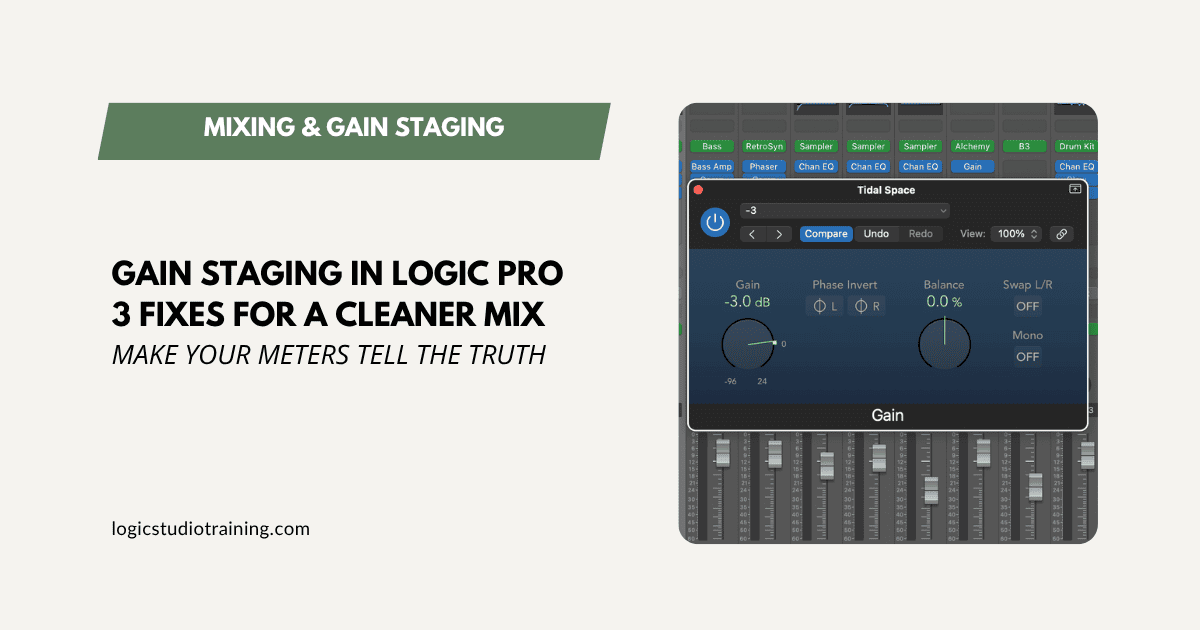
- Open the Gain plugin.
Go to Utility > Gain and slap it at the very top of your channel strip, before any EQs, compressors, or saturation plugins. (This is also why gain sits first in a well-ordered chain: see where EQ and compression belong.) - Set your target level.
Play the loudest section of the track, and use the Gain plugin to adjust until the peak hits around -12 dBFS.
If you want extra headroom, aim for -18 dBFS. That's the analog sweet spot most plugins are modeled on.
For example, let's say you recorded vocals and the waveform is practically a solid block. Pull it back with the Gain plugin until it breathes. You'll immediately hear more detail and less distortion in any compressor you add after.
Step 2: Stop Chasing Faders. Use Pre-Fader Meters.
Logic has a powerful tool tucked away in the mixer.
By default, Logic's meters show you what's happening after the fader. But you don't want to measure your mess after you've already moved the fader.
To see the real levels:
- Right-click the meter in the mixer and choose "Pre-Fader Metering."
- Now, when you adjust the Gain plugin, you're seeing how hot your signal really is before it hits the fader or any plugins.
This matters more than it sounds.
If your synth is slamming at +3 dB and your fader is pulled down to -12, it looks fine, but your plugins are still overloaded. You're EQing clipped audio and wondering why everything sounds harsh.
Pre-fader metering shows you what's really going on, and that's what leads to cleaner mixes. It's the same honesty principle behind level matching your plugins: trust what the signal is actually doing, not what it looks or sounds like after you've nudged it.
Step 3: Reset Your Faders to Unity and Build From There
Once your gain staging is dialed in, your faders go back to being useful mix tools instead of damage control.
Reset your mix foundation like this:
- Pull all your faders to 0 dB (unity gain).
This is your new neutral starting point, rather than some random place you landed after dragging things around for an hour. - Use the Gain plugin to balance your instruments.
Instead of juggling faders to make the bass quieter, reduce its gain upstream. Then, when you do reach for the faders, every move is intentional rather than a reaction to chaos.
Here's a quick level template to aim for:
- Vocals: -18 to -12 dBFS peak
- Drums: -10 to -6 dBFS peak (kick and snare)
- Instruments: -18 to -12 dBFS peak
- Buses: Should sum to around -6 to -3 dBFS total before the master
That keeps you well out of the red, with plenty of headroom for mastering, or for plugins that love analog-style input levels.
TL;DR: Your Gain Staging Cheat Sheet
- Insert a Gain plugin first in every channel.
- Set peaks around -12 to -18 dBFS.
- Turn on Pre-Fader Metering.
- Reset faders to 0 dB. Use Gain for balance, faders for mixing.
- Keep your mix bus under -6 dB before mastering plugins.
Forget more plugins or a $300 EQ. What actually cleans up your mix is gain staging that makes sense.
Do it once, and your next mix sounds instantly cleaner. Your plugins start working the way they're supposed to, and Logic Pro finally feels like a tool that's on your side.
Now go open a session and make those meters honest. Your next mix will show it.
Free Download
Get the Free Logic Pro Mixing Cheat Sheet
The essential mixing reference for Logic Pro — key settings, signal flow, and mix decisions on one page. Enter your name and email and I'll send it right over.
Your information stays private. No spam, no sharing, ever.
Excellent! This article has really changed the way I approach a mix. I can hear the difference. It is a real pleasure to achieve this kind of result. It is also a pleasure to receive and read your newsletter every time. Many thanks!
Wow. That means a lot to hear. Seriously. The fact that it’s actually helping you hear the difference? That’s the whole mission. Thanks for reading, thanks for trusting the process, and thanks for sticking around.